I wrote a while ago about the difficulty I had in getting my mental values and my dedication of resources in alignment. Since it's been a while, I wanted to check in on this again. I haven't written about it, but I've been turning this topic over in my head. Over the past months, I've been reading on my own and discussing with online folks how they approach it.
I think the most obvious change is that my intended work field is in alignment. Working as an archaeologist, anthropologist, or conservator means understanding and preserving different cultures. Additionally, the funding for this work usually comes from the government or private foundations. This work is very different than where I started out, interested in military funded work in mechanical engineering. My work goals are very much in line with what I believe should be done: I think we should collectively contribute to understanding world culture, unite ourselves to protect and promote learning and collaboration. I'm proud that I will be working in a way that aligns with my values; the guilt-free joy is probably the foundation for continuing my course work at this point.
The other changes are more personal. I practice political celibacy and I absolutely refuse to contribute my energy to being drained by men. I'm very at peace with being ace; I don't feel pressure to give my energy to men or ashamed of the intimacy I feel for my female friends. Lesbian has at last been defanged as an insult. Looking back, I'm amazed at the pain I felt and the knots I twisted myself into over being accused of being a lesbian. I mean that truly, the accusatory tone intended in something that should never be used as an insult! I've cut pornography out of my life for almost 5 years now. I want to increase my focus on sisterhood and supporting women in my life. It's so easy to get caught up in comparison and envy. We are trained early on that there can only be one token in our field, that all the good men will be grabbed by other women, that the happiness of others detracts from our own. I want to unpack this in myself in order to find ways to give meaningfully to other women.
I think the big change that I need to make is to do political activist work. During the past three years, I was very focused on conquering my own little corner of the world. My activist work was focused on supporting women of color in my dorm. Be it serving as an Associate Advisor to encourage women and support them during their freshman year at a prestigious engineering school or hosting tea parties to make space to talk with and embrace the women I lived with in an antagonistic co-ed dorm, all of my work has been very small scale. Most this activism I would now describe as consciousness raising. While the personal is political, I think the gap is that I haven't worked or acted on anything that is explicitly political.
I don't think that individual consumer choices are particularly effective in advocating for political change, but they have eased my conscience since I last wrote. I enjoy shopping mainly at Whole Foods mainly because of the quality of the food. Not because I'm sure my $50 fair trade purchase is going to change the way a global food economy operates. I'm also aware that many other people in my neighborhood can't afford to shop at Whole Foods, much less dedicate the time and effort to home cooking. But this sort of liberal choice activism has been a foundation of my 'work' since I first confronted the gap between my words and actions. I want to make the big step into doing real work!
I'm not sure how to begin political activist work. I hope that I can share the journey I go on, as I slowly figure it out. Most likely I'll start small with volunteer work.
Showing posts with label my life. Show all posts
Showing posts with label my life. Show all posts
Saturday, August 23, 2014

Tuesday, August 19, 2014
Summer Time Stress Less
I wanted to keep track of some changes that I noticed over the summer. By noting the positive effects of the summer, I hope that I can extend some of them into the school year.
The main change is that I am so much less stressed. I'd attribute it to a few core things: leaving the stress of work at 5pm, not living in a dorm, having a very stable routine. For me, most things are bearable if I know they have an ending! There's something extraordinarily stressful about a surprise flare up. I think that establishing a routine for the school year would be very helpful in lowering my stress level during the year. For establishing that boundary of routine, I will have a commute. Similarly, demarcating end points for projects, even if they're only internal, would help me to plan out my time and decrease my stress. So I'm going to dedicate the time I spend on campus to studying. I hope that my establishing a boundary between home and school work will decrease my stress the way the external boundary I had over the summer did.
I've noticed that I have less acne this summer! This might seem like a small thing and my acne isn't that bad, but I've been very frustrated with my acne flaring up during the school year. Acne can hurt! I have the bad habit of distractedly scratching my face when I'm stressed; I even scratch in my sleep. So even a minor acne flare up before finals can be quickly compounded. But my skin has been so clear over the summer that I haven't even needed BBcream! I think less stress as well as being able to drink more water helped with the acne. It's amazing - and a little scary - to see the physical effects that come with stress. I'm going to keep up with drinking water during the year!
The other aspect that I think has helped with my stress - and probably the acne too - is that I've been cooking for myself. I've cut down on eating out and frozen meals. Almost all of the food I've eaten over the past month has been food I made at home from scratch. I'm really not sure if Whole Food's organic food was a significant contribution to the health benefits, but I know that cutting out processed food made a big difference. I also tried out a farm share during the summer but it didn't work out due to the amount and selection of food. I'm so proud of trying out so many different recipes and sources. Experimenting with some failures led to accomplishing this major success! It really wouldn't seem possible based on where I was when I first came to college. And even looking at the start of this year, I'm glad that I've extended myself way past eating breakfast everyday. My new goal is to make all of my meals at home! I do still have my snack food weakness, anything chocolate based and bite sized, but I've also found a healthy granola that I really like to snack on at work. I can literally feel the difference in my energy levels now that I am eating whenever I feel hungry. My energy and mood stay nice and even rather than crashing; my work productivity also stays high. So I think that eating regularly and more healthily has made a big difference in my stress and energy levels. I want to keep that momentum for the school year!
Over the summer, I've read a number of books. I made myself a promise that I wasn't buying any more books until I finished reading the ones I already own. I'm amazed by the progress I've been making on that front! I've read all of my kindle books over the commute. I read through an introductory museum book at work. I'm now light reading through some course books for the fall term. Additionally, I've been keeping up with a few blogs. In turn, this reading has kept up my passion for writing for my blog. I never read this much during the school year, both as far as breadth and depth. I love reading and it seems like I had forgotten that, bogged down in coursework. It's great to have the time and focus to pursue my reading interests outside of coursework.
My summertime has really had less stress than the school year. Even with some external stressors, I'm still feeling more relaxed than I do over the term. By writing this out, I think I've got a more clear understanding of what changes caused this relaxation. Hopefully, implementing these significant changes during the term will lead to the same less stressed result.
The main change is that I am so much less stressed. I'd attribute it to a few core things: leaving the stress of work at 5pm, not living in a dorm, having a very stable routine. For me, most things are bearable if I know they have an ending! There's something extraordinarily stressful about a surprise flare up. I think that establishing a routine for the school year would be very helpful in lowering my stress level during the year. For establishing that boundary of routine, I will have a commute. Similarly, demarcating end points for projects, even if they're only internal, would help me to plan out my time and decrease my stress. So I'm going to dedicate the time I spend on campus to studying. I hope that my establishing a boundary between home and school work will decrease my stress the way the external boundary I had over the summer did.
I've noticed that I have less acne this summer! This might seem like a small thing and my acne isn't that bad, but I've been very frustrated with my acne flaring up during the school year. Acne can hurt! I have the bad habit of distractedly scratching my face when I'm stressed; I even scratch in my sleep. So even a minor acne flare up before finals can be quickly compounded. But my skin has been so clear over the summer that I haven't even needed BBcream! I think less stress as well as being able to drink more water helped with the acne. It's amazing - and a little scary - to see the physical effects that come with stress. I'm going to keep up with drinking water during the year!
The other aspect that I think has helped with my stress - and probably the acne too - is that I've been cooking for myself. I've cut down on eating out and frozen meals. Almost all of the food I've eaten over the past month has been food I made at home from scratch. I'm really not sure if Whole Food's organic food was a significant contribution to the health benefits, but I know that cutting out processed food made a big difference. I also tried out a farm share during the summer but it didn't work out due to the amount and selection of food. I'm so proud of trying out so many different recipes and sources. Experimenting with some failures led to accomplishing this major success! It really wouldn't seem possible based on where I was when I first came to college. And even looking at the start of this year, I'm glad that I've extended myself way past eating breakfast everyday. My new goal is to make all of my meals at home! I do still have my snack food weakness, anything chocolate based and bite sized, but I've also found a healthy granola that I really like to snack on at work. I can literally feel the difference in my energy levels now that I am eating whenever I feel hungry. My energy and mood stay nice and even rather than crashing; my work productivity also stays high. So I think that eating regularly and more healthily has made a big difference in my stress and energy levels. I want to keep that momentum for the school year!
Over the summer, I've read a number of books. I made myself a promise that I wasn't buying any more books until I finished reading the ones I already own. I'm amazed by the progress I've been making on that front! I've read all of my kindle books over the commute. I read through an introductory museum book at work. I'm now light reading through some course books for the fall term. Additionally, I've been keeping up with a few blogs. In turn, this reading has kept up my passion for writing for my blog. I never read this much during the school year, both as far as breadth and depth. I love reading and it seems like I had forgotten that, bogged down in coursework. It's great to have the time and focus to pursue my reading interests outside of coursework.
My summertime has really had less stress than the school year. Even with some external stressors, I'm still feeling more relaxed than I do over the term. By writing this out, I think I've got a more clear understanding of what changes caused this relaxation. Hopefully, implementing these significant changes during the term will lead to the same less stressed result.
Tuesday, August 12, 2014
An Examination of Passing
I feel that a large portion of my college learning has been learning how to pass.
And I have learned how to pass in a lot of ways: race, economic class, religion, location, political, gender.
Passing has in some ways been a concerted effort on my part. I choose to go to MIT because I wanted to get away from some things, racism being one of them. Like in tales of the tragic mulatto, once I made it North I found that race suddenly became less of a hindrance. No longer did I get questions of "What are you? What are you mixed with? Are you from [insert country]?" from classmates or passerby on the street. (Yes, strangers have approached me to ask questions about my race in VA.) I didn't get questions about my choice to go the MIT rather than a HBU from my new professors. My white friends didn't approach me for the secrets of relaxer, Brazil straightening, or twist outs. By some definitions, I have made no effort to hide my race. I have worked with and run events with the Office of Minority Education; I talk about my experience of being biracial; I write and read about racial issues; I do not alter my hair or skin to hide my race. Is just going to a school in another state hiding my race?
But I do pass! I can't calculate what combination of changes in my behavior, appearance, or perceived identity have changed that I can regularly pass for white. But I do. And I get benefits from that. And I've gained knowledge to pass in other ways too. What I mean is, even if I'm not making a conscious effort to pass right now, if I did want to make that effort I would now have the knowledge to do so.
It take a surprising amount of information and self-vigilance to pass. Ask yourself some questions focusing on economic passing: What is the cost of a meal plan vs cooking? Which is more common on campus? Are dining halls a social meeting place that cooking would exclude you from? If so, can friends bring a guest for free? What are the right kinds and brands of clothes to wear? How much do these clothes cost? What sort of trip for spring break have most college students gone on? What about traveling/studying abroad? How much does this sort of travel cost? Are you expected to have traveled before? What percentage of your campus was Greek affiliated? What is the cost of joining a sorority? Before being asked these questions, were you aware that you would need to know or prepare for these costs? If you didn't have to think about it, you're probably in the economic position that I am passing for. In order to pass, I have to weigh all of these options to find what I can fake and what I have to let go.
Some of it is about making things "presentable." I'm always amused by the careful balance that women are expected to play in professional settings. Women are paid more if they wear the "correct" amount of make up at work and are attractive. But engineers mock and belittle women who are 'vain' enough to adorn themselves. Of course, these engineers often don't know whether a person is wearing make up. I've had people say I looked ill when I skipped a day of concealer and I've had people compliment my eyeshadow when my face was completely bare. I once asked a male friend if he thought I wore make up. He responded no. I was talking with a different female friend who doesn't wear make up and she admitted that she thought I was always wearing make up. The truth of course is in the middle. The perception of the reality is more static. I can get away with a day without make up because most days people perceive that I look a certain way. Similarly, I can get away with being a little more stingy with money because I can present the right signs of affluence. The reality of race, class, or gender doesn't have to be there, just the presentation for others.
And the guidelines for passing vary every so slightly on the situation. It takes an incredible amount of knowledge and reading of a situation to pass appropriately. Women are encouraged to dress appropriately for their gender based on the setting. Once while working a public event for the Smithsonian, a patron suggested that one of the staff members wear a dress like she had last week, saying that she didn't look lady-like in her capris and blouse. Meanwhile, my course 3 presentation advice has been to wear pant suits or pencil skirts rather than dresses, to avoid earrings because they are distracting, and other careful limitations on femininity. It's like playing one of those cell phone games where you tilt your phone to balance. Even when you're sure you're holding your phone level, the stupid game has you sliding to the left. When you tilt just a smidge to correct, suddenly you're too far to the right! Always you have to be vigilant of where you hands are, subtly adjusting them while keeping an eye on the situation and score.
Some of my 'education' in passing has been unintentional. I wouldn't venture to say it was forced, but it would have been difficult not to change. I used to have a mild Southern accent and speech patterns from growing up in northern Virginia. While I didn't use 'ain't' on a regular basis, I was apparently an interesting spectacle of the South. Spectacle enough to be asked to perform! "Say daughter! Say drawer! Say crayon! Say crown!" Now I don't think that most people intended to be insulting or make me uncomfortable. A few friends complimented me on my lilting tone. But! Imagine if someone with a speech impediment or foreign accent was asked to perform this sort of thing: it would clearly be inappropriate. The reason I speak with a Southern accent and use certain phrases is because I am a mulatto woman from the South and grew up as such. Some of my family is from further south: Georgia. My grandmother attended church and said 'ain't' when she was pressed. Pages have been written to validate AAV as a valid form of expression. But the social pressure to speak with a very particular type of Northern accent is pervasive. Over time, my accent decreased. I don't know the slang or expressions currently used in what was once my community. I now pass in a way I had never even intended to. In fact it would take the conscious effort to NOT pass.
I know that this doesn't really have a clear cut moral or lesson. I just wanted to write this out. I think that I would have wanted to know that this informal education was going to be such a significant part of my life when I was picking out schools. I guess to some degree I knew because I had a really adverse reaction to the privilege I encountered at Dartmouth; I knew I didn't want to spend four years becoming more like that, or even getting used to folks like that.
And I have learned how to pass in a lot of ways: race, economic class, religion, location, political, gender.
Passing has in some ways been a concerted effort on my part. I choose to go to MIT because I wanted to get away from some things, racism being one of them. Like in tales of the tragic mulatto, once I made it North I found that race suddenly became less of a hindrance. No longer did I get questions of "What are you? What are you mixed with? Are you from [insert country]?" from classmates or passerby on the street. (Yes, strangers have approached me to ask questions about my race in VA.) I didn't get questions about my choice to go the MIT rather than a HBU from my new professors. My white friends didn't approach me for the secrets of relaxer, Brazil straightening, or twist outs. By some definitions, I have made no effort to hide my race. I have worked with and run events with the Office of Minority Education; I talk about my experience of being biracial; I write and read about racial issues; I do not alter my hair or skin to hide my race. Is just going to a school in another state hiding my race?
But I do pass! I can't calculate what combination of changes in my behavior, appearance, or perceived identity have changed that I can regularly pass for white. But I do. And I get benefits from that. And I've gained knowledge to pass in other ways too. What I mean is, even if I'm not making a conscious effort to pass right now, if I did want to make that effort I would now have the knowledge to do so.
It take a surprising amount of information and self-vigilance to pass. Ask yourself some questions focusing on economic passing: What is the cost of a meal plan vs cooking? Which is more common on campus? Are dining halls a social meeting place that cooking would exclude you from? If so, can friends bring a guest for free? What are the right kinds and brands of clothes to wear? How much do these clothes cost? What sort of trip for spring break have most college students gone on? What about traveling/studying abroad? How much does this sort of travel cost? Are you expected to have traveled before? What percentage of your campus was Greek affiliated? What is the cost of joining a sorority? Before being asked these questions, were you aware that you would need to know or prepare for these costs? If you didn't have to think about it, you're probably in the economic position that I am passing for. In order to pass, I have to weigh all of these options to find what I can fake and what I have to let go.
Some of it is about making things "presentable." I'm always amused by the careful balance that women are expected to play in professional settings. Women are paid more if they wear the "correct" amount of make up at work and are attractive. But engineers mock and belittle women who are 'vain' enough to adorn themselves. Of course, these engineers often don't know whether a person is wearing make up. I've had people say I looked ill when I skipped a day of concealer and I've had people compliment my eyeshadow when my face was completely bare. I once asked a male friend if he thought I wore make up. He responded no. I was talking with a different female friend who doesn't wear make up and she admitted that she thought I was always wearing make up. The truth of course is in the middle. The perception of the reality is more static. I can get away with a day without make up because most days people perceive that I look a certain way. Similarly, I can get away with being a little more stingy with money because I can present the right signs of affluence. The reality of race, class, or gender doesn't have to be there, just the presentation for others.
And the guidelines for passing vary every so slightly on the situation. It takes an incredible amount of knowledge and reading of a situation to pass appropriately. Women are encouraged to dress appropriately for their gender based on the setting. Once while working a public event for the Smithsonian, a patron suggested that one of the staff members wear a dress like she had last week, saying that she didn't look lady-like in her capris and blouse. Meanwhile, my course 3 presentation advice has been to wear pant suits or pencil skirts rather than dresses, to avoid earrings because they are distracting, and other careful limitations on femininity. It's like playing one of those cell phone games where you tilt your phone to balance. Even when you're sure you're holding your phone level, the stupid game has you sliding to the left. When you tilt just a smidge to correct, suddenly you're too far to the right! Always you have to be vigilant of where you hands are, subtly adjusting them while keeping an eye on the situation and score.
Some of my 'education' in passing has been unintentional. I wouldn't venture to say it was forced, but it would have been difficult not to change. I used to have a mild Southern accent and speech patterns from growing up in northern Virginia. While I didn't use 'ain't' on a regular basis, I was apparently an interesting spectacle of the South. Spectacle enough to be asked to perform! "Say daughter! Say drawer! Say crayon! Say crown!" Now I don't think that most people intended to be insulting or make me uncomfortable. A few friends complimented me on my lilting tone. But! Imagine if someone with a speech impediment or foreign accent was asked to perform this sort of thing: it would clearly be inappropriate. The reason I speak with a Southern accent and use certain phrases is because I am a mulatto woman from the South and grew up as such. Some of my family is from further south: Georgia. My grandmother attended church and said 'ain't' when she was pressed. Pages have been written to validate AAV as a valid form of expression. But the social pressure to speak with a very particular type of Northern accent is pervasive. Over time, my accent decreased. I don't know the slang or expressions currently used in what was once my community. I now pass in a way I had never even intended to. In fact it would take the conscious effort to NOT pass.
I know that this doesn't really have a clear cut moral or lesson. I just wanted to write this out. I think that I would have wanted to know that this informal education was going to be such a significant part of my life when I was picking out schools. I guess to some degree I knew because I had a really adverse reaction to the privilege I encountered at Dartmouth; I knew I didn't want to spend four years becoming more like that, or even getting used to folks like that.
Saturday, July 19, 2014
Daily Make Up
Here's the make up that I use on a day to day basis. My style is a very natural mori-girl type look. These products are reliable: they create a quick but gorgeous day to day look. Not only that but these products work well with your natural look. They compliment you!
 I can't wait to share with you the looks so:
Read more for the run through of items!

I try to make sure that my day to day look is pretty natural. To me, daily make up should easy and quick to do. The purpose isn't to change what you look like: it's to bring out your positive features.


Read more for the run through of items!

I try to make sure that my day to day look is pretty natural. To me, daily make up should easy and quick to do. The purpose isn't to change what you look like: it's to bring out your positive features.
- Pixi Lid Last Shimmer Eye ($18)
- Pixi Endless Silky Eye Pen ($15)
- Pixi Tinted Brilliance Lip Balm ($16)
- Burt's Bee's Sensitive Eye Cream ($15)
- Physician's formula matte palette ($7)
- L'Oreal True Match Concealer Crayon ($8 per)
- Eye liner (I switch which brand I get)
- L'Oreal Color Riche Lipstick (Links to review, $8)
- Purpose Moisturizer spf 15 ($13)
- Maybelline BB Creme ($7)
If folk are interested, I can do a full tutorial of these items for my daily look.

Tuesday, January 7, 2014
Moving
I am moving into an apartment!
That's right - I'm moving out of the dorm and into an off campus apartment.
I'm super excited for the move; I can't even describe how done I am with dorm life and how excited I am to have my own space.
With a caveat, I am moving in with a friend, and temporarily, her boyfriend.
I'm also going to be getting intense with my MFA internship so I hope to have real things to talk about rather than the radio silence I've been imposing on you guys.
As soon as my furniture arrives I will have tons of pictures to post.
That's right - I'm moving out of the dorm and into an off campus apartment.
I'm super excited for the move; I can't even describe how done I am with dorm life and how excited I am to have my own space.
With a caveat, I am moving in with a friend, and temporarily, her boyfriend.
I'm also going to be getting intense with my MFA internship so I hope to have real things to talk about rather than the radio silence I've been imposing on you guys.
As soon as my furniture arrives I will have tons of pictures to post.
Saturday, December 21, 2013
Me, myself, and I
I am struggling.
I am really honestly struggling most of the time.
When I say that I'm struggling, I don't mean that I'm failing. I mean that I have kept myself just above water all on my own with no fall back plan.
I am going to MIT on scholarships and my part time work. I don't have a fall back. I couldn't transfer out of an engineering degree without losing my scholarships. I can't get a lower GPA or I will lose my scholarship. There is no one to pay my student contribution. If I lose my job, I don't have a relative to give me one. If I don't pay my bills, it's my credit on the line not a family member's. I don't have any such family members. Even my FAFSA recognizes - I am an independent; it's just me.
There is really just me.
I am doing the best I can with the resources I have.
I have by all accounts done exceptionally well. Something like 50% of foster care alumni haven't completed a high school education and something like 15% end up in prison. 66% will be homeless, go to jail, or die within a year of leaving the foster care system at 18. Foster care alumni have higher rates of depressive episodes than the general population. Suicide rates for teens is about 7%.
I have completed high school and am working towards a degree at MIT. I haven't self harmed in almost a year. I have a plan of action for my depressive episodes that involves a stable clinician.
But when I look to other students at MIT, I see kids with very different resources. A lot of kids here have parents with PhDs. Some of the parents can help their kids with their work. Most of the kids here are not first generation; a good college has been expected of them since always. They go home to their mother and father knowing that they are safe and loved, unconditionally. They can email their psets to their parents and expect the questions to be understood and maybe even some guidance in answering them.
I don't have any of that. I don't have the financial security of college educated family. I don't have the educational support of STEM educated parents. I don't have the emotional security of being able to go home to my bio family.
This isn't meant to be a source of pity. I don't spend my time sitting around feeling sorry for myself. If I did I wouldn't be where I am. But I do need to deal with this reality. Because of the tendency to 'curve' class grades,
I simply mean to acknowledge that this responsibility is on my shoulders.
This is the reality I have been dealing with since I was 14.
I have learned how to deal with things to keep myself safe and head above water.
But I would like to have my grades from MIT show my skill. Not just my managing to survive skill. But my actual skill, when I am at the same place of safety as the other students.
I am really honestly struggling most of the time.
When I say that I'm struggling, I don't mean that I'm failing. I mean that I have kept myself just above water all on my own with no fall back plan.
I am going to MIT on scholarships and my part time work. I don't have a fall back. I couldn't transfer out of an engineering degree without losing my scholarships. I can't get a lower GPA or I will lose my scholarship. There is no one to pay my student contribution. If I lose my job, I don't have a relative to give me one. If I don't pay my bills, it's my credit on the line not a family member's. I don't have any such family members. Even my FAFSA recognizes - I am an independent; it's just me.
There is really just me.
I am doing the best I can with the resources I have.
I have by all accounts done exceptionally well. Something like 50% of foster care alumni haven't completed a high school education and something like 15% end up in prison. 66% will be homeless, go to jail, or die within a year of leaving the foster care system at 18. Foster care alumni have higher rates of depressive episodes than the general population. Suicide rates for teens is about 7%.
I have completed high school and am working towards a degree at MIT. I haven't self harmed in almost a year. I have a plan of action for my depressive episodes that involves a stable clinician.
But when I look to other students at MIT, I see kids with very different resources. A lot of kids here have parents with PhDs. Some of the parents can help their kids with their work. Most of the kids here are not first generation; a good college has been expected of them since always. They go home to their mother and father knowing that they are safe and loved, unconditionally. They can email their psets to their parents and expect the questions to be understood and maybe even some guidance in answering them.
I don't have any of that. I don't have the financial security of college educated family. I don't have the educational support of STEM educated parents. I don't have the emotional security of being able to go home to my bio family.
This isn't meant to be a source of pity. I don't spend my time sitting around feeling sorry for myself. If I did I wouldn't be where I am. But I do need to deal with this reality. Because of the tendency to 'curve' class grades,
I simply mean to acknowledge that this responsibility is on my shoulders.
This is the reality I have been dealing with since I was 14.
I have learned how to deal with things to keep myself safe and head above water.
But I would like to have my grades from MIT show my skill. Not just my managing to survive skill. But my actual skill, when I am at the same place of safety as the other students.
Monday, November 18, 2013
Check in: Jumbled Thoughts
Periodically I find that I have to check in with myself and my values.
I was talking with a floor mate and she insisted that we have to 'prioritize' things. By this she meant that some values and truths that we find to be important we have to set aside, ignore the injustice of breaking them and the harm that this ignorance causes. She said that you had to 'pick your battles,' that you couldn't do everything.
Insistently, I said that we could do everything, that there was no cause so trivial to be put aside. I found her statements repugnant: It's an impossible and disrespectful task to determine which life is more worthy of your time. Lifestyles are inherently political; all aspects of a lifestyle should be aligned with the individual's moral views. While resources may be limited, ingenuity is not. If your morals do not apply to your actions, you do not actually believe your morals. I tried to explain how I structured my life in alignment with this belief.
In some places I could clearly articulate what I meant: I changed majors from something that was based in military applications (mechanical engineering) to one that was not only harmless but an important part of conserving the world's culture (art conservation). Even my achievement and choice of university was a political statement: a raised-poor biracial woman can go to MIT to pursue a degree in engineering. I could also explain how I choose to purchase products that are generally organic and/or fair trade. I could even point to the fact that I was engaging in this conversation and the risk I have faced in spreading my beliefs.
However in other places, I found myself struggling to find the bright line between my intent and my effect. While I don't believe that individual choices within capitalism are a means of changing our larger social structure, I find that it is irresponsible to ignore the meaning in small changes of purchasing and responsibility. For example, I don't think that my recycling is going to fix America's lack of sustainability. On the other hand, I can't point to any direct action I've taken to change America's policies outside of my own awareness and the individual conversations I've had. Pointing to the resources available, I can say how much fair trade food I can afford to seek out and buy. But I cannot find a way to choose which products to purchase, which to 'prioritize.'
Always, articulating your values to another person is a valuable experience because it forces you to confront contradictions and vacancies. Because of this conversation, I came to a better understanding of what I want and what I am doing. Basically I know that I'm not causing harm but I am not actually making progress towards my beliefs being adopted by others or helping others.
I want to find out how I can better bring my daily actions in line with my values. In particular, I've increasingly been focused on how to turn my feminism into practice. What does 'solidarity with women' mean? I live on a women's floor. I choose to write my papers on women's contributions with women authors. I read and think about women's issues. But what does this mean in daily practice?
I would love to hear how others balance this or put their beliefs into practice. I think this is something that will take a long time for me to fully achieve, but I do want to begin working towards the goals I see for myself and the world. If I can speak about change, I must also act as I speak.
I was talking with a floor mate and she insisted that we have to 'prioritize' things. By this she meant that some values and truths that we find to be important we have to set aside, ignore the injustice of breaking them and the harm that this ignorance causes. She said that you had to 'pick your battles,' that you couldn't do everything.
Insistently, I said that we could do everything, that there was no cause so trivial to be put aside. I found her statements repugnant: It's an impossible and disrespectful task to determine which life is more worthy of your time. Lifestyles are inherently political; all aspects of a lifestyle should be aligned with the individual's moral views. While resources may be limited, ingenuity is not. If your morals do not apply to your actions, you do not actually believe your morals. I tried to explain how I structured my life in alignment with this belief.
In some places I could clearly articulate what I meant: I changed majors from something that was based in military applications (mechanical engineering) to one that was not only harmless but an important part of conserving the world's culture (art conservation). Even my achievement and choice of university was a political statement: a raised-poor biracial woman can go to MIT to pursue a degree in engineering. I could also explain how I choose to purchase products that are generally organic and/or fair trade. I could even point to the fact that I was engaging in this conversation and the risk I have faced in spreading my beliefs.
However in other places, I found myself struggling to find the bright line between my intent and my effect. While I don't believe that individual choices within capitalism are a means of changing our larger social structure, I find that it is irresponsible to ignore the meaning in small changes of purchasing and responsibility. For example, I don't think that my recycling is going to fix America's lack of sustainability. On the other hand, I can't point to any direct action I've taken to change America's policies outside of my own awareness and the individual conversations I've had. Pointing to the resources available, I can say how much fair trade food I can afford to seek out and buy. But I cannot find a way to choose which products to purchase, which to 'prioritize.'
Always, articulating your values to another person is a valuable experience because it forces you to confront contradictions and vacancies. Because of this conversation, I came to a better understanding of what I want and what I am doing. Basically I know that I'm not causing harm but I am not actually making progress towards my beliefs being adopted by others or helping others.
I want to find out how I can better bring my daily actions in line with my values. In particular, I've increasingly been focused on how to turn my feminism into practice. What does 'solidarity with women' mean? I live on a women's floor. I choose to write my papers on women's contributions with women authors. I read and think about women's issues. But what does this mean in daily practice?
I would love to hear how others balance this or put their beliefs into practice. I think this is something that will take a long time for me to fully achieve, but I do want to begin working towards the goals I see for myself and the world. If I can speak about change, I must also act as I speak.
Saturday, November 9, 2013
Recharge and Refocus
I took a few days off of blogging to recharge. Life seems to get more and more daunting as I move forward. But there are also a few amazing changes that I want to share.
The first is that I think I'm going to move out of my dorm. While the people on my floor are lovely, I find the dorm culture to be a bit toxic and too transitory for my taste. This is something that I've been looking forward to as an abstract thought for a while, but it's much closer to becoming a reality than ever before.
The second is that I'm trying to make a monetary commitment to myself. I have enough things lying around, not all of them being used, that I don't need to buy anymore. I want to make sure that I'm financially stable as I move out and that I start saving money the way I really should be.
Finally, I want to do the things that I set out to do over the summer. I want to draw twice a week. I want to read all the books I've purchased. I want to go back to writing letter. I've been dealing with difficulty and stress. In general, I really just lost sight of what I'm doing and who I am because I was too caught up in the stress of the moment and the difficulty of the moment. I want to get back in touch with the ideal me that I was working to be, rather than the miasmic discouraged me.
The first is that I think I'm going to move out of my dorm. While the people on my floor are lovely, I find the dorm culture to be a bit toxic and too transitory for my taste. This is something that I've been looking forward to as an abstract thought for a while, but it's much closer to becoming a reality than ever before.
The second is that I'm trying to make a monetary commitment to myself. I have enough things lying around, not all of them being used, that I don't need to buy anymore. I want to make sure that I'm financially stable as I move out and that I start saving money the way I really should be.
Finally, I want to do the things that I set out to do over the summer. I want to draw twice a week. I want to read all the books I've purchased. I want to go back to writing letter. I've been dealing with difficulty and stress. In general, I really just lost sight of what I'm doing and who I am because I was too caught up in the stress of the moment and the difficulty of the moment. I want to get back in touch with the ideal me that I was working to be, rather than the miasmic discouraged me.
Tuesday, July 30, 2013
Internship advice
I'm going to do a few posts to provide advice for interns. I really struggled when I first got my internship with all sorts of questions. This is certainly natural: most minimum wage jobs and academic settings are a completely different work paradigm than an office job or internship.
These posts will provide some basic advice for interns, from starting out to finishing up.
These are a few key approaches to be an amazing intern.
Your internship is really just a very long interview. Receiving an internship is just getting your foot in the door; you still have to continue to be an amazing potential employee. You haven't made it in yet. While you should be proud of landing the internship, you should realize that this is just the first step to making a good impression at the company and with your supervisor. Even if it seems that you will be likely give the job, look further: you can still see this as an interview for the next job that you apply for or the promotion that you will want.
Much like an interview, every day you should be on your best behavior, looking out for pitfalls and opportunities.
Gratitude is an amazing thing to demonstrate. People are always happy to help someone who take the time to pat them on the back and return that help. Especially in well established companies and those jobs that gave you your first experience, gratitude for the opportunity to work is expected.
Write thank you letters for being interviewed, for recommendation letters, for being mentored, for the opportunity to work. If you can, give back some sort of value to the person who helped you. This could be sharing a bright idea that they inspired, pointing out an opportunity for funding, or offering to put them in contact with a professor at your school who you think they would get along with. They helped you so you should do your best to help them.
Don't discount what you can do to help them! These small acts coming from you now will signal how truly motivated you are and that you will be an important professional connection.
Thank you letters should be well written in content and put on nice stationary. An email will not cut it.
When you first get an assignment, ask questions about it. Try and get a sense not only of what you are asked to do, but why and what your supervisor truly wants. Don't pretend like you know what you're doing. It's better to ask questions than make mistakes.
Here are some useful questions:
Basic details
Work quickly and efficiently but make sure to keep up the quality of your work. Proof read everything you do. The best way I've found to proof read is to print out everything and read what I've written multiple times.
Once you know what is wanted of you and what is being asked of you, do both and add your own spin to it. If you can, add some sort of innovation to the task. Are you making an event program from Word document? Make the program in Publisher; explain to your supervisor that it will be easier to print. Create several designs for the event program, designs that fit with the feeling the event is going for. Do everything you can to make a perfect product.
I also ask other coworkers to look things over or bounce ideas before speaking to my supervisor. This shows initiative and, when I credit the coworker for sharing their idea, humility and good teamwork.
You are you. You can do a lot to become a better worker. But to be a truly excellent intern, you need to show yourself as an excellent worker and as someone who can add to the company.
What you add is about who you are.
If you're an amazing social butterfly and spend tons of hours running events for your sorority, take that to your job. Be Elle Woods. If you're a quiet dreamer with tons of ideas, work them over in your mind and then share them. Take your inspiration from the imagination and rectitude of Tesla. If your social skills are so so, but you love the technical side of things find an office that understands this, find a task where you technical skills can shine as you work independently, find your niche.
You can't be happy constantly changing who you are; you can't be a good worker if you hide your best aspects.
These posts will provide some basic advice for interns, from starting out to finishing up.
These are a few key approaches to be an amazing intern.
Attitude: Interview
Your internship is really just a very long interview. Receiving an internship is just getting your foot in the door; you still have to continue to be an amazing potential employee. You haven't made it in yet. While you should be proud of landing the internship, you should realize that this is just the first step to making a good impression at the company and with your supervisor. Even if it seems that you will be likely give the job, look further: you can still see this as an interview for the next job that you apply for or the promotion that you will want.
Much like an interview, every day you should be on your best behavior, looking out for pitfalls and opportunities.
Thank you letters
Gratitude is an amazing thing to demonstrate. People are always happy to help someone who take the time to pat them on the back and return that help. Especially in well established companies and those jobs that gave you your first experience, gratitude for the opportunity to work is expected.
Write thank you letters for being interviewed, for recommendation letters, for being mentored, for the opportunity to work. If you can, give back some sort of value to the person who helped you. This could be sharing a bright idea that they inspired, pointing out an opportunity for funding, or offering to put them in contact with a professor at your school who you think they would get along with. They helped you so you should do your best to help them.
Don't discount what you can do to help them! These small acts coming from you now will signal how truly motivated you are and that you will be an important professional connection.
Thank you letters should be well written in content and put on nice stationary. An email will not cut it.
Proofread and Perfect
When you first get an assignment, ask questions about it. Try and get a sense not only of what you are asked to do, but why and what your supervisor truly wants. Don't pretend like you know what you're doing. It's better to ask questions than make mistakes.
Here are some useful questions:
Basic details
- Would you like this saved as a pdf or word document?
- Should I print this in color?
- Who should I copy on this email?
- When do you want this by?
- What is the target audience of this project/publication?
- What is the goal of this project/publication?
- Do you have an previous examples?
- How was this program developed?
- What is the latest innovation for this program?
Work quickly and efficiently but make sure to keep up the quality of your work. Proof read everything you do. The best way I've found to proof read is to print out everything and read what I've written multiple times.
Share ideas and innovation
Having asked meaningful questions about the project, think about the project. How would you run this project? What could be added to the project? Where would there be problems?Once you know what is wanted of you and what is being asked of you, do both and add your own spin to it. If you can, add some sort of innovation to the task. Are you making an event program from Word document? Make the program in Publisher; explain to your supervisor that it will be easier to print. Create several designs for the event program, designs that fit with the feeling the event is going for. Do everything you can to make a perfect product.
I also ask other coworkers to look things over or bounce ideas before speaking to my supervisor. This shows initiative and, when I credit the coworker for sharing their idea, humility and good teamwork.
The point
You are you. You can do a lot to become a better worker. But to be a truly excellent intern, you need to show yourself as an excellent worker and as someone who can add to the company.
What you add is about who you are.
If you're an amazing social butterfly and spend tons of hours running events for your sorority, take that to your job. Be Elle Woods. If you're a quiet dreamer with tons of ideas, work them over in your mind and then share them. Take your inspiration from the imagination and rectitude of Tesla. If your social skills are so so, but you love the technical side of things find an office that understands this, find a task where you technical skills can shine as you work independently, find your niche.
You can't be happy constantly changing who you are; you can't be a good worker if you hide your best aspects.
Saturday, July 27, 2013
College Men's Common Criticisms of Feminism
It seems like if you get a group of college kids together, late at night when there's just enough trust to let conversations start flowing, it's inevitable that a guy will steer the conversation toward a critique of feminism.
Why do guys feel so much of a need to harp on feminism?
And if guys want to criticize feminism, why do they only want to criticize it when they feel that the criticism isn't going to leave a safe space?
Read more for the common criticisms and my run down on why this happens.
The things that men always bring up against feminism:
If these are honest concerns for the sake of advancing women, why don't they bring them up publicly? For the benefit of everyone? For the benefit of their beloved "equal-ism"?
The answer is of course that these aren't for the benefit of feminism. These criticisms are really just worries that college guys have about losing their privilege. These guys voice their loss of power to encourage their female friends to give men back power, to placate their male friends with subservience and docile explanations for why we women folk have encroached so far.
And their concerns reveal and underlying ignorance and backlash that ought to motivate women even more to pursue feminism. It's so angering to hear these "criticisms" again and again, as if feminists haven't written extensively on these topics already.
Why do guys feel so much of a need to harp on feminism?
And if guys want to criticize feminism, why do they only want to criticize it when they feel that the criticism isn't going to leave a safe space?
Read more for the common criticisms and my run down on why this happens.
The things that men always bring up against feminism:
- privilege isn't real because i don't think i benefit from it
- bonus points for a story of a bootstrapping story of independent success
- if feminism is about equality why is it femin-sim? why not equal-ism?
- bonus points for claiming men and women are equal because we can both vote
- women pay less of car insurance so there's no such thing as a pay gap
- bonus points for claiming women's low car insurance is strange since women can't drive
- why are women so upset that they have to shave their legs? i shave my beard
- bonus points for challenging women to find a guy who doesn't care
- but really, friend zone
- bonus points for stories of personal experience
- i knew this one girl who was a bitch... so... yeah
- bonus points if the girl wasn't actually a bitch
- girls get benefits from being hot so it's not bad to want them to be hot
- bonus points for claiming natural beauty is more attractive anyway
- it's a natural thing for guys to be agressive and it's encouraged by society for the good of everyone
- bonus points for also claiming that women can just ignore all societal expectation
If these are honest concerns for the sake of advancing women, why don't they bring them up publicly? For the benefit of everyone? For the benefit of their beloved "equal-ism"?
The answer is of course that these aren't for the benefit of feminism. These criticisms are really just worries that college guys have about losing their privilege. These guys voice their loss of power to encourage their female friends to give men back power, to placate their male friends with subservience and docile explanations for why we women folk have encroached so far.
And their concerns reveal and underlying ignorance and backlash that ought to motivate women even more to pursue feminism. It's so angering to hear these "criticisms" again and again, as if feminists haven't written extensively on these topics already.
Saturday, July 20, 2013
Moving Forward From Failure: Get Started!
I find failure to be the most difficult thing to overcome. Maybe it's the fact that failure had such a high cost in my youth. Maybe it's just that failure represents the effort put into the attempt not being quite enough.

But here's what I do to get over my fear of failure and get started on a project.

During our youth, it seems that many of us were told that talent or intelligence meant never failing, having things come to us easily. Therefore, when we face difficulty or worse yet failure, we question one of the fundamentals of our identity: our talent. The ideology behind this comes from the concept of a Romantic genius, a person with natural talent whose work far exceeds what practice and route learning can achieve in the untalented.
But this is a silly notion. Even the Romantic geniuses had failures!
Friedrich did studies for his paintings; even The Wanderer had its precursor. Chalk Cliffs is nowhere near the statement as the The Wanderer. It's not a shame to the artist that he went through a process of refinement for his ideas. That's what failure is: the process of improvement.Van Gogh did not immediately paint a perfect canvas: often he painted over his failures, adapting them to the improvement of his next work.
Our greatest fear seems to be that we will be laughed at or mocked for our failures.
Let's remember van Gogh. Most art historians lament that he painted over his "failures." They wish that they could see the process that he went through, much as they pour over the sketches of those painters trained by the French Academy.
And okay, somebody laughed at your failure? So what? What are they doing? Instead of taking that time to be improving themselves, they're paying attention to you. If anything, that means that you're already succeeding. You're gaining attention for your new work. You've got an audience for your future success. You're making someone else feel happy, maybe a vindictive happy that reflects on their inner demons, but still happy. So don't worry about it.
"I spent so much time working on it but it didn't turn out right."
"Look at all the money that went into that ugly thing! What a waste."
"My reputation's ruined by that fiasco. No one will let me try again!"
We've all heard or said these things about our own efforts that ended in failure.
But what have we said about the profits of success?
Consider failures investments. Don't jump into large ones; slowly build. Develop a skill. It only takes a single success to put you on the market, but all success requires skill.
In the case of drawing: Start out on cheap newsprint as you learn to draw or paint. Invest in a few nice sketchbooks. When those are filled, you'll see improvement. You'll have the wisdom to choose the style and medium that best suits you. A few quality finished works on canvas will yield more and more knowledge, based on the sketches you continue to do on cheap paper. Finally, you'll have a piece that satisfies you. You can send this succes to a gallery where it may or may not be accepted. But you will always have the skill of drawing, a skill that can continue to grow.

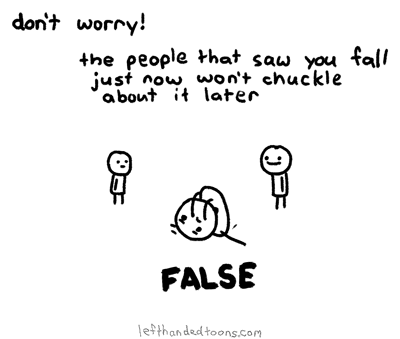
via: Left handed toons People don't actually laugh at our failures
But here's what I do to get over my fear of failure and get started on a project.

Mentally Approaching Failure
During our youth, it seems that many of us were told that talent or intelligence meant never failing, having things come to us easily. Therefore, when we face difficulty or worse yet failure, we question one of the fundamentals of our identity: our talent. The ideology behind this comes from the concept of a Romantic genius, a person with natural talent whose work far exceeds what practice and route learning can achieve in the untalented.
But this is a silly notion. Even the Romantic geniuses had failures!
Friedrich did studies for his paintings; even The Wanderer had its precursor. Chalk Cliffs is nowhere near the statement as the The Wanderer. It's not a shame to the artist that he went through a process of refinement for his ideas. That's what failure is: the process of improvement.Van Gogh did not immediately paint a perfect canvas: often he painted over his failures, adapting them to the improvement of his next work.
Fear of Mockery
Our greatest fear seems to be that we will be laughed at or mocked for our failures.
Let's remember van Gogh. Most art historians lament that he painted over his "failures." They wish that they could see the process that he went through, much as they pour over the sketches of those painters trained by the French Academy.
And okay, somebody laughed at your failure? So what? What are they doing? Instead of taking that time to be improving themselves, they're paying attention to you. If anything, that means that you're already succeeding. You're gaining attention for your new work. You've got an audience for your future success. You're making someone else feel happy, maybe a vindictive happy that reflects on their inner demons, but still happy. So don't worry about it.
The Cost of Failure
"I spent so much time working on it but it didn't turn out right."
"Look at all the money that went into that ugly thing! What a waste."
"My reputation's ruined by that fiasco. No one will let me try again!"
We've all heard or said these things about our own efforts that ended in failure.
But what have we said about the profits of success?
Consider failures investments. Don't jump into large ones; slowly build. Develop a skill. It only takes a single success to put you on the market, but all success requires skill.
In the case of drawing: Start out on cheap newsprint as you learn to draw or paint. Invest in a few nice sketchbooks. When those are filled, you'll see improvement. You'll have the wisdom to choose the style and medium that best suits you. A few quality finished works on canvas will yield more and more knowledge, based on the sketches you continue to do on cheap paper. Finally, you'll have a piece that satisfies you. You can send this succes to a gallery where it may or may not be accepted. But you will always have the skill of drawing, a skill that can continue to grow.

Saturday, July 6, 2013
10 Things You'll Love About Being Home on Break
Let's get back to the positive side after the post of 10 Things you'll miss about college on break!
Lesson: It's good to vent and verbalize the things that bother you, but refocus on the things that you enjoy. Figure out how to add more of the 10 things you love and remove the 10 things you don't.
Read more for the list of 10 things you'll love about being home!

These are the things that I love about being home:

Lesson: It's good to vent and verbalize the things that bother you, but refocus on the things that you enjoy. Figure out how to add more of the 10 things you love and remove the 10 things you don't.
Read more for the list of 10 things you'll love about being home!

These are the things that I love about being home:
- Being with your family
- Your own precious bed
- Flipping motherfudger kid-cussing
- Catching up with local friends
- Avoiding dorm drama
- Home cooked meals
- Early bedtime and good rest
- Your own bathroom to arrange as you like
- Free laundry for your clothes
- No stressful exams

Tuesday, July 2, 2013
10 Things About College You'll Miss on Break
There are a lot of great things about college - the level of independence that you get to experience - things that you lose when you go home for break. Sitting here in Virginia, I'm thinking about the things I miss about Boston and the MIT campus.
Read more for my list of 10 things about college you'll miss on break.

If you are returning to the suburbs from the city, then you're probably missing the ability to walk wherever you want to. And maybe you've gotten roped into driving a sibling somewhere. You don't realize it while you're at college, but the ability to go where you want to when you want to without answering to your parents is really great.
Whatever the rules are for your dorm, I'm sure you've found the time and place to blast your music. Your home, however, probably doesn't have a place to blast music. And it's likely that even if you could blast your music, the commentary from parents and siblings would ruin the joy of airing your music out.
This one is obvious. Even if you're in the same area, it's different to live with someone and see them all the time vs. schedule a meet up to get coffee. I really do miss seeing my college friends all the time and our little impromptu hot chocolate runs.
I found that college really changed my politics. I now have very different politics than the people in my home; even my approach to discussing politics has changed.
Everyone knows that college kids eat a lot of snacks and take out. But when we return home, we get all sorts of sass for eating poorly. I don't think that the occasional snack is bad, but it's hard to convince the parents to buy it.
College might not start until noon, but the rest of the world wakes up to start at 9am. It can be a painful transition back to the early bird life, especially if you want to chat with college friends that live in a later time zone.
I don't think that I'm particularly mess but when I'm working on a project I do like to have my things spread out. Also, I'm one of those people that's opposed to making their bed. But when I'm at home, I have to make my bed and clean up all my things each night. If I don't there's a scolding waiting for me!
I do love different gyaru, mori and lolita fashions, but no one at home knows what these things are, much less understands them. Even in the case of wanting to wear party clothes, there's really no opportunity. Work and family don't understand your clothing choices the way college students with similar interests do.
I won't say much about this but I think we all know that boredom starts to set in a few weeks after break starts.

Read more for my list of 10 things about college you'll miss on break.

1. Going where you want to when you want to
If you are returning to the suburbs from the city, then you're probably missing the ability to walk wherever you want to. And maybe you've gotten roped into driving a sibling somewhere. You don't realize it while you're at college, but the ability to go where you want to when you want to without answering to your parents is really great.
2. Blasting music
Whatever the rules are for your dorm, I'm sure you've found the time and place to blast your music. Your home, however, probably doesn't have a place to blast music. And it's likely that even if you could blast your music, the commentary from parents and siblings would ruin the joy of airing your music out.
3. Cussing
I don't cuss that much, but I do relish the occasional swear when the moment is right. The moment is never right at home. Worse than that, if I slip out a cuss word a younger sibling will parrot it back a million times.4. Seeing your college friends
This one is obvious. Even if you're in the same area, it's different to live with someone and see them all the time vs. schedule a meet up to get coffee. I really do miss seeing my college friends all the time and our little impromptu hot chocolate runs.
5. Avoiding the home-town politics
I found that college really changed my politics. I now have very different politics than the people in my home; even my approach to discussing politics has changed.
6. Getting tons of take out and snacks
Everyone knows that college kids eat a lot of snacks and take out. But when we return home, we get all sorts of sass for eating poorly. I don't think that the occasional snack is bad, but it's hard to convince the parents to buy it.
7. Waking up late
College might not start until noon, but the rest of the world wakes up to start at 9am. It can be a painful transition back to the early bird life, especially if you want to chat with college friends that live in a later time zone.
8. Leaving your room a mess
I don't think that I'm particularly mess but when I'm working on a project I do like to have my things spread out. Also, I'm one of those people that's opposed to making their bed. But when I'm at home, I have to make my bed and clean up all my things each night. If I don't there's a scolding waiting for me!
9. Wearing whatever clothes you want
I do love different gyaru, mori and lolita fashions, but no one at home knows what these things are, much less understands them. Even in the case of wanting to wear party clothes, there's really no opportunity. Work and family don't understand your clothing choices the way college students with similar interests do.
10. Academics
I won't say much about this but I think we all know that boredom starts to set in a few weeks after break starts.

Tuesday, June 25, 2013
Internship Update
I wanted to give a little update on how my internship has been going.
Read more to find out how things have been going!
I'm currently in the Public Programs Office; I'm working on an assortment of projects along with staffing evening events. Most projects are small internal paper work things, organizing things in Excel, or helping with the Family Days. I kind of want to work through a few mini-classes in Excel. My experience with tutoring and teaching has been really useful for prepping for the Family Days. I think the most exciting part of the internship is staffing the events: it gives you a real sense of the role the museum plays in the community.
I'm in the Public Programs Office, External Affairs. The Public Programs Office is really great. Everyone is super friendly at the Smithsonian. That was one of the first things that struck me about the environment. But this office just goes beyond, filled with enthusiastic and cheerful people. I'm amazed by the scope of these women's work: they do so many programs for the American Art and Renwick. And there are just five of them!
The space itself is an office in the Smithsonian American Art Museum offices in the Victor Building and the museum itself, which is right across the street. This is all right outside of the Gallery/Chinatown metro stop; I just ride the yellow line straight in. I also sometimes make my way to the other Smithsonian museums for research, trainings, special events, or just for my own pleasure.
I'm trying to take the time this summer to learn as much as I can about the Smithsonian and it's programs. I want to leave with a strong understanding of how museums organize themselves and how individuals can best help a museum. I'd love to see how my understanding of the museum's role for the community changes as I help to staff events rather than just attend them as a guest.
I also want to learn more about professional development; I feel very disconnected at MIT since we don't have a strong program for Art History or Studio Art. Hopefully, I can take the resources and people to find out and connect to the career of conservation.
I'm going to start writing about my internship; I do want to give it a little bit of time so that I can process my experiences and deliver the best information. Also, there is the consideration of privacy and respecting the museum. I doubt that any posts on proper attire or behavior would brush against that, but I need the time to go over things and make sure they are fully in line with the museum's policies.
I might also write about interesting things that are in the museum's catalogue. As I do research, I come across all sorts of neat little gems within the catalogues. Not to mention that it would help to expand my knowledge and yours too!
Read more to find out how things have been going!
What I do
I'm currently in the Public Programs Office; I'm working on an assortment of projects along with staffing evening events. Most projects are small internal paper work things, organizing things in Excel, or helping with the Family Days. I kind of want to work through a few mini-classes in Excel. My experience with tutoring and teaching has been really useful for prepping for the Family Days. I think the most exciting part of the internship is staffing the events: it gives you a real sense of the role the museum plays in the community.
Where I am
I'm in the Public Programs Office, External Affairs. The Public Programs Office is really great. Everyone is super friendly at the Smithsonian. That was one of the first things that struck me about the environment. But this office just goes beyond, filled with enthusiastic and cheerful people. I'm amazed by the scope of these women's work: they do so many programs for the American Art and Renwick. And there are just five of them!
The space itself is an office in the Smithsonian American Art Museum offices in the Victor Building and the museum itself, which is right across the street. This is all right outside of the Gallery/Chinatown metro stop; I just ride the yellow line straight in. I also sometimes make my way to the other Smithsonian museums for research, trainings, special events, or just for my own pleasure.
What I'm learning
I'm trying to take the time this summer to learn as much as I can about the Smithsonian and it's programs. I want to leave with a strong understanding of how museums organize themselves and how individuals can best help a museum. I'd love to see how my understanding of the museum's role for the community changes as I help to staff events rather than just attend them as a guest.
I also want to learn more about professional development; I feel very disconnected at MIT since we don't have a strong program for Art History or Studio Art. Hopefully, I can take the resources and people to find out and connect to the career of conservation.
Why I'm sharing
I'm going to start writing about my internship; I do want to give it a little bit of time so that I can process my experiences and deliver the best information. Also, there is the consideration of privacy and respecting the museum. I doubt that any posts on proper attire or behavior would brush against that, but I need the time to go over things and make sure they are fully in line with the museum's policies.
I might also write about interesting things that are in the museum's catalogue. As I do research, I come across all sorts of neat little gems within the catalogues. Not to mention that it would help to expand my knowledge and yours too!
Saturday, June 22, 2013
Rousseau: Perpetual restraint vs. Honest commitment
People seem to become more and more homogeneous as time goes on. Think of the rapid spread of galaxy print. Quickly galaxy went from a few instances of NASA photoshopping, to a DIY trend, and on to widespread commercial products. Maybe it's the success of corporations managing to sell us all the same product in a million different ways. Maybe it's the process of information becoming more quickly and widely available.

Even in the 18th century process of people trying to fall into a mold was happening. Rousseau writes in Discourses on the Arts and Sciences on the prevalence of modern manners.
Read more for a quote of his ideas and my thoughts on individuality despite outside pressure.

What is certain is that the homogenization make individuality more difficult. It's hard to be your unique self when everyone else seems to have poured themselves into a single cast. I remember in high school when everyone wore Abercrombie and Fitch, capped sleeves and color scheme down to a precise formula. Now, the uniform is more subtle and encroaches on behavior.
Apparently, it's absolutely not okay to not have a plan for after graduation as a freshman nor is it alright to purchase your brass rat after graduation, even if these decisions are based on your finances. If you've ever worn a costume on the T, the adult uniform is revealed by its absence. The conformity is deceptive in how everyone seems to easily fall into it, willingly. But it's there.
So how do you break out of the mold that's been made invisible by ubiquity?
How does one stand up for their individuality while still being presentable for interviews?
Part of embracing the everyday is embracing who you are. Get in touch with what you want then work to pursue that. The persistence to follow your dream will also show your value as an individual amongst so many identical replicates. Get in touch with the powerful motives that will give you strength to be yourself. Once you have a goal, pursue it regardless of decorum. If you want to be more fashionable, try out new coordinates regardless of what dullards warn about changing your style. Reach out to communities that pursue the similar styles; don't be afraid of being the first person to speak.
People who share your goal will make useful allies and even better friends; you know they will stay strong beside you because they too have gone through the difficulty of breaking out of the mediocre. Most likely, they'll be far more welcoming and warm as you discuss something exciting you both love than those bound by polite conversation about the weather.
Reading Rousseau on this subject gave me confidence and I hope that it can give you confidence too. Being yourself can give you a lot of insight on the true friends in your life. Don't worry about people that are uncomfortable with you embracing yourself. Be open and honest with your advice. The true friends are the people that stick around and care while others ignore or try to disparage you.

via Britannica
Even in the 18th century process of people trying to fall into a mold was happening. Rousseau writes in Discourses on the Arts and Sciences on the prevalence of modern manners.
Read more for a quote of his ideas and my thoughts on individuality despite outside pressure.

The Quote
"In our day, now that more subtle study and a more refined taste have reduced the art of pleasing to a system, there prevails in modern manners a servile and deceptive conformity; so that one would think every mind had been cast in the same mould. Politeness requires this thing; decorum that; ceremony has it s forms, and fashion its laws, and these we must always follow, never the promptings of our own nature.
We no longer dare seem what we really are, but lie under a perpetual restraint; in the meantime the herd of men, which we call society, all act under the same circumstances exactly alike, unless very particular and powerful motives prevent them. Thus we never know with whom we have to deal; and even to know our friends we must wait for some critical and pressing occaison; that is, till it is too late; for it is on those very occasions that such knowledge is of use to us."
from Rousseau, A Discourse on the Arts and Sciences, The First Part
Homogenization by Choice
What is certain is that the homogenization make individuality more difficult. It's hard to be your unique self when everyone else seems to have poured themselves into a single cast. I remember in high school when everyone wore Abercrombie and Fitch, capped sleeves and color scheme down to a precise formula. Now, the uniform is more subtle and encroaches on behavior.
There prevails in modern manners a servile and deceptive conformity
Apparently, it's absolutely not okay to not have a plan for after graduation as a freshman nor is it alright to purchase your brass rat after graduation, even if these decisions are based on your finances. If you've ever worn a costume on the T, the adult uniform is revealed by its absence. The conformity is deceptive in how everyone seems to easily fall into it, willingly. But it's there.
So how do you break out of the mold that's been made invisible by ubiquity?
How does one stand up for their individuality while still being presentable for interviews?
Unique Self
Part of embracing the everyday is embracing who you are. Get in touch with what you want then work to pursue that. The persistence to follow your dream will also show your value as an individual amongst so many identical replicates. Get in touch with the powerful motives that will give you strength to be yourself. Once you have a goal, pursue it regardless of decorum. If you want to be more fashionable, try out new coordinates regardless of what dullards warn about changing your style. Reach out to communities that pursue the similar styles; don't be afraid of being the first person to speak.
Valuable Friends
Let go of friends that don't stand by you. Friends who haven't stayed with you aren't guaranteed friends. Don't go out creating a crisis. Do pay attention to who comforts you, even in the small things. Trust me: those people will also show up when you truly need it.Thus we never know with whom we have to deal; and even to know our friends we must wait for some critical and pressing occaison; that is, till it is too late; for it is on those very occasions that such knowledge is of use to us.
People who share your goal will make useful allies and even better friends; you know they will stay strong beside you because they too have gone through the difficulty of breaking out of the mediocre. Most likely, they'll be far more welcoming and warm as you discuss something exciting you both love than those bound by polite conversation about the weather.
Reading Rousseau on this subject gave me confidence and I hope that it can give you confidence too. Being yourself can give you a lot of insight on the true friends in your life. Don't worry about people that are uncomfortable with you embracing yourself. Be open and honest with your advice. The true friends are the people that stick around and care while others ignore or try to disparage you.
Tuesday, May 28, 2013
Classroom Etiquette
One of the most important things for college is the new code of etiquette for college lectures. It's very different from high school but still important for making sure that your professor has a good opinion of you.

Here's my guide to lectures and college classes, how you should behave in lecture. The advice will go through cellphones, bathroom breaks, sleeping and more.

Here's my guide to lectures and college classes, how you should behave in lecture. The advice will go through cellphones, bathroom breaks, sleeping and more.
- going to the bathroom
At my high school, we had passes to go to the bathroom. It was very embarrassing: students had to get the teacher's attention and signature in a pass book to go to the bathroom. Even worse, for each class, you were only allowed to go to the bathroom twice a semester.
Fortunately, college lectures allow you to go to the bathroom whenever you want. It is of course preferable to go before or after class, but in the case of emergencies it's easy to slide off during a lull. Many professors even have a mid-lecture break if allotted more than an hour.
In my mind, there's no shame in needing to use the bathroom and I don't much care if students or professors judge me for drinking lots of water and then needing to use the restroom. Your body needs what your body needs.
- eating and drinking
Eating is really up to the professor. Some professors will make clear at the start of class their policy on eating, especially if it's verboten. Most don't mind students drinking water or coffee during a morning class along with a quiet granola bar. Evening classes tend to be quite lax about food policies, often expecting students to eat. For example, my Monday evening class goes from 7 pm - 10 pm so the professor told us on the first lecture that food was alright.
I'd personally suggest something you can pick up and put down while taking notes. As always, try to eat quietly without making a mess. Nachos for example are a bad idea: loud and messy salsa. Foods without strong odors are considerate of the people around you.
- sleeping
Of course you shouldn't be sleeping in class. But we all have moments where we dose off during a particularly dull lecture due to a late night cramming.
If you expect to be falling asleep, consider skipping the class. There's nothing to be gained from sleeping through a lecture; it may even reflect worse on you than missing one lecture. If you decide to attend and sleep through, sit in the back of the class. There's nothing worse for you and others than being the student snoring in the front row.
If you absolutely don't want to fall asleep but may fall to temptation, have a friend or seat mate periodically tap you to wake you up. It may be a little embarrassing to ask a stranger sitting next to you for a favor, but that embarrassment may also keep you from falling asleep.
- cellphone
Put your cell phone on silent during lecture.
Let me repeat that: Cell phones should be on silent during class.
This isn't high school; no one's going to confiscate your phone. But everyone will turn to look at you, especially if you have a hilarious song for your ring tone.
Personally, I suggest putting your cell phone on your lap during lecture so that you can check the time without loudly rummaging through your bag. If the professor has a no cell phone policy, turn your phone off and leave it in your bag to totally minimize the temptation.
- laptops
Most professors have a clear policy on laptops. If they're allowed, try not to drift off topic while using them; some professors will walk around the room in order to get a view of your laptop.
If laptops aren't allowed, they're really not allowed. Don't bring them.
- late/leaving
If you are entering late or leaving early, try to do so respectfully. If you know in advance, send the professor an email before the lecture to apologize and explain. If it's just a case of sleeping in, enter the room quietly and accept the fact that you may have to settle for a seat in the back. If you need to interrupt other students' view or the position of the lecturer to get when you need to be, wait until a natural pause.
For important reasons to leave, pack your bag quickly and quietly. Often it's easier to dump everything in your bag and reorganize outside of the lecture hall rather than deal with the dirty looks from students trying to take notes.
Unlike high school, it's normal that you have other commitments and most college classes don't take attendance. There's no need to feel terrible for a few late entries or early leavings so long as you are considerate of others. Most likely a professor won't remember the one time a student shows up late so long as there wasn't a scene. Don't sweat it. Just be polite.
- chatting
Whisper. To. The. Person. Next. To. You.
Stop talking when lecture starts. There's nothing that professors hate more than not being able to start their lecture on time because of people obliviously chatting. Take note of the time and quiet down when lecture is supposed to start; it's for your own good to make sure that the prof gets through all the material. I've had a few professors who have put material that wasn't covered in lecture on exams because they blamed chatty Cathys for not making it through the information in class. Don't be that kid.
Do not yell to the person across the room. Don't pass notes. Don't constantly text. These are the other things that professors notice.
If you have questions, you are super welcome to comment so that we can share our experiences and advice.
Stop talking when lecture starts. There's nothing that professors hate more than not being able to start their lecture on time because of people obliviously chatting. Take note of the time and quiet down when lecture is supposed to start; it's for your own good to make sure that the prof gets through all the material. I've had a few professors who have put material that wasn't covered in lecture on exams because they blamed chatty Cathys for not making it through the information in class. Don't be that kid.
Do not yell to the person across the room. Don't pass notes. Don't constantly text. These are the other things that professors notice.
If you have questions, you are super welcome to comment so that we can share our experiences and advice.
Saturday, May 25, 2013
Fresh Plants and Flowers
I love spring time. I love the way the weather warms up and then takes the time for little spring showers to cool down. We should all take the time to slow down. Going on long walks helps me to breath in that fresh air that gives so much life to everything. Keeping live plants at my desk really warms up my study space, but I sometimes want flowers along with my leafy green. I want to bring into my room more of the spring that is around me.

I've been getting cut flowers to keep in my room. Read more to see the flowers that I've been getting and hear about my experience.
I adored having these flowers in my room. I don't know what it is exactly about flowers that makes my mood soar, but there is something. If I could figure out what it was, I'd bottle it up and use it for every day.

I get flowers at either the grocery store or at the florist. Fortunately, I have coupons for the florist. For those of you worried about cost, most cut flowers last about for one or two weeks. By changing the water regularly with sugar added in, you can extend the flower's lifespan to a tad over two weeks.
My one warning would be that cut flowers have pollen in them. That might seem obvious, but if you have allergies it could be a problem, especially in a small room. Ask the florist which flowers don't have too much pollen.

I've been getting cut flowers to keep in my room. Read more to see the flowers that I've been getting and hear about my experience.
I adored having these flowers in my room. I don't know what it is exactly about flowers that makes my mood soar, but there is something. If I could figure out what it was, I'd bottle it up and use it for every day.

I get flowers at either the grocery store or at the florist. Fortunately, I have coupons for the florist. For those of you worried about cost, most cut flowers last about for one or two weeks. By changing the water regularly with sugar added in, you can extend the flower's lifespan to a tad over two weeks.
My one warning would be that cut flowers have pollen in them. That might seem obvious, but if you have allergies it could be a problem, especially in a small room. Ask the florist which flowers don't have too much pollen.
Saturday, May 18, 2013
Mini Update: Packing
Heya,
I've been packing to productive procrastinate on my last final and paper. I turned in two papers earlier this week. Just not feeling this last paper happening.
It's funny how everyone has taken a very "it's almost over; i don't even care" attitude for these last two weeks. Spring semester, man; it's been tough on all of us here in Boston. I should have a post on that after the 24th!
I've been packing to productive procrastinate on my last final and paper. I turned in two papers earlier this week. Just not feeling this last paper happening.
It's funny how everyone has taken a very "it's almost over; i don't even care" attitude for these last two weeks. Spring semester, man; it's been tough on all of us here in Boston. I should have a post on that after the 24th!
Sorry but, no full updates until after the 24th.
<3Sunday, May 12, 2013
End of Term
It's absolutely amazing to think that it's the end of the semester. Next year I will be a junior! There are so many exciting things to talk about: an exciting summer job, studying for exams, packing for a return to Virginia.
Due to finals there won't be any more posts until after May 24th, when I return to Virginia. After that, I will return to schedule.
Read more for my thoughts on the end of term and summer plans.
Finals are something that I start prepping for at the start of May, so I'm not drowning in cramming. However there was a major surprise from MIT about Random Hall going through construction and Bexley being closed for the next couple of years. This threw me off schedule for studying. I have a take home exam, a final, and two papers to write. Most of my things are organized to be packed up. Taking the time to pack up also means taking the time to purge my room of things I don't adore. For the summer, I'm going to be storing my things at a paid storage facility; thankfully, MIT should be covering this cost.
So many opportunities and knowledge have come to me, but through this year my goal has been to acknowledge these opportunities as a gift. No one is owed anything so to be gifted kindness, knowledge, and kinship is something really valuable. Easy to overlook, but difficult to find. I've been focusing on improving myself, reading and breathing to appreciate what I have.
This year, every day of it, has been a gift. Low points and high points are part of the process of living; I want to appreciate them as an opportunity for growth and self-possesion.
I'm thinking of getting a part time work-from-home job since the Smithsonian internship isn't paid. I'd like to have something to give me a little bit of spending money and some savings to start off my junior year.
For play, I'm going to be having some of my college friends over. I've already got the full plans for a friend coming over for Otakon! Link to read about Otakon, an amazing anime convention in Baltimore, Maryland. This summer will be my third year attending. Another friend may be dropping by sometime during the summer since she fell a bit in love with Virginia after visiting for Thanksgiving.Also, I'm considering going to see Motion City Soundtrack for their concert July 9th at Virginia Beach.
With an increased amount of free time, I want to work on my blog. I really want to step it up to the next level. My goals are to create a banner, signature, line break, and maybe even an extra feature for each week. I'd really like to work on my graphic design and art; utilizing that toward the blog would give me a good schedule and motivation.
I would also like to get back into Youtube and creating videos. It's something that I've always enjoyed but don't seem to block out time for.
If there's anything you want to see in the blog or from me in general, please let me know!
Due to finals there won't be any more posts until after May 24th, when I return to Virginia. After that, I will return to schedule.
Read more for my thoughts on the end of term and summer plans.
Semester Wrap Up: Academics
To think that I'm half-way through my college career is crazy. I just can't believe it; it feels like the time is flying past me. Truth: college takes a lot of sustained work and concentrated dedication. I've felt the wear down of the year when winter was in its coldest, but as the weather warmed up so did I. Not to mention the lift that my floor mates and friends provided. I'm intensely grateful for the friends that I've made. For them and myself, I want to keep up the effort and the energy for the next two years, staying focused on making myself happy and learning rather than weakly stumbling through.Finals are something that I start prepping for at the start of May, so I'm not drowning in cramming. However there was a major surprise from MIT about Random Hall going through construction and Bexley being closed for the next couple of years. This threw me off schedule for studying. I have a take home exam, a final, and two papers to write. Most of my things are organized to be packed up. Taking the time to pack up also means taking the time to purge my room of things I don't adore. For the summer, I'm going to be storing my things at a paid storage facility; thankfully, MIT should be covering this cost.
Gratitude: The Year as a Gift
There's so much that I'm grateful for, even as I struggle through finals and packing and all the things that come with the wrap up of the year. The winding down of the year puts so many things into perspective. My low points this year are also a way to get back down to my foundation.So many opportunities and knowledge have come to me, but through this year my goal has been to acknowledge these opportunities as a gift. No one is owed anything so to be gifted kindness, knowledge, and kinship is something really valuable. Easy to overlook, but difficult to find. I've been focusing on improving myself, reading and breathing to appreciate what I have.
This year, every day of it, has been a gift. Low points and high points are part of the process of living; I want to appreciate them as an opportunity for growth and self-possesion.
Upcoming Summer: Work and Play
My summer job is an internship with the Smithsonian American Art. Link through to read about the summer program internship for SI American Art. I'm so excited for this amazing opportunity. There's no way for me to express how much it means to me to be stepping forward toward my dream of working in a museum, to be working with art and towards the purpose of preservation, outreach, and education. I adore the Smithsonian and can basically guarantee that I'll spend my summer gushing about it. If you're also interested in this type of work: Check out the Smithsonian's page for summer internships.I'm thinking of getting a part time work-from-home job since the Smithsonian internship isn't paid. I'd like to have something to give me a little bit of spending money and some savings to start off my junior year.
For play, I'm going to be having some of my college friends over. I've already got the full plans for a friend coming over for Otakon! Link to read about Otakon, an amazing anime convention in Baltimore, Maryland. This summer will be my third year attending. Another friend may be dropping by sometime during the summer since she fell a bit in love with Virginia after visiting for Thanksgiving.Also, I'm considering going to see Motion City Soundtrack for their concert July 9th at Virginia Beach.
Summer Blogging
With an increased amount of free time, I want to work on my blog. I really want to step it up to the next level. My goals are to create a banner, signature, line break, and maybe even an extra feature for each week. I'd really like to work on my graphic design and art; utilizing that toward the blog would give me a good schedule and motivation.
I would also like to get back into Youtube and creating videos. It's something that I've always enjoyed but don't seem to block out time for.
If there's anything you want to see in the blog or from me in general, please let me know!
Saturday, May 4, 2013
Positivity: Spring Refresh
I want to see how my new year's resolutions have been going, possibly recommitting on the ones that aren't doing as well on.

Read more for the break down on how I've been doing!

Read more for the break down on how I've been doing!
- Draw Every Day
I haven't been doing so well on this. But I have been drawing more often than last semester. I'm even nearly through with my sketch book. Overall, I think that this goal might need to be broken down a little bit more so that I can measure my progress on it.
- Blog Post Weekly
I have been doing this. In fact, I've been blogging twice weekly. I think that I may step it up to three times a week in a month or so. Blogging is really rewarding and works well with my self reflection. While I may not have a lot of readers now, I feel accountable writing down what I have and haven't done.
- Work Out
This semester I'll be taking a yoga and pilates class this term. I'm a little worried about the pilates, but I'll have a friend with me. I'm going to be trying to attend the Friday Concourse Yoga. I tried to have a work out buddy for working out in my dorm, but we were stymied by conflicting schedules, so I may just work out on my own in the Z-center.
- Cook and Pack Lunches
I've actually been been staying in the dorm for lunch, so I haven't been having to pack up. I do think that I should be cooking more. It'll be easier to do this as the weather warms up and grocery shopping becomes less of a chore.
- Confidence Increase
Maybe my confidence has increased. Seems like I am more content with myself, most likely due to the self reflection I've been focusing on. I feel much happier with the choices that I've been making, especially since it seems like I'm moving closer to my goal.
- Morning Yoga
Not too well on this resolution. I'm going to re-commit to this for the spring. I think this will also help with the difficulty I have getting out of bed. This links back to the working out resolution, so hopefully they'll rise together.
- Talk to Ivanna x2 weekly
I have been doing very well on this. I write a letter every week and usually make a phone call or text throughout the week. To step up the commitment, I want to start taking a photo once a week to text to her which would also work well for blogging.
- Drink 8 cups of water / day
While I may not be all the way up to 8 cups a day, I have consistently been drinking water before going the sleep and right after waking up. I think I'm averaging 6 cups a day, focused in the evening. To be quite honest, I feel like I need to drink far more than 8 cups a day.
- Keep My Room Clean
Victory! My room has actually been getting cleaner and neater. I emptied and condensed a number of things, leading to less clutter overall. If I can keep this up for the spring, I may reward myself by buying another small dresser for my beauty supplies and pajamas.
Overall, I feel that I've been doing well on my new year's resolutions. I am adding a few more resolutions, stepping it up a little bit.
Subscribe to:
Posts (Atom)